192.168.1.1 Router Login and Admin Panel Guide
The complete guide to accessing your router at 192.168.1.1. Find the right credentials for your brand, fix login problems, and lock down your network properly.
Summary
- Private IP address. Only reachable within your local network. No one outside your home can access it.
- Admin interface. Full control over Wi-Fi, DHCP, DNS, firewall, port forwarding, and firmware.
- Default gateway. The bridge between every device on your home network and the public internet.
- Password protected. Always requires login credentials. Factory defaults should be changed straight away.
At a glance
All IPspassword, or printed on the labelWhat Is 192.168.1.1?
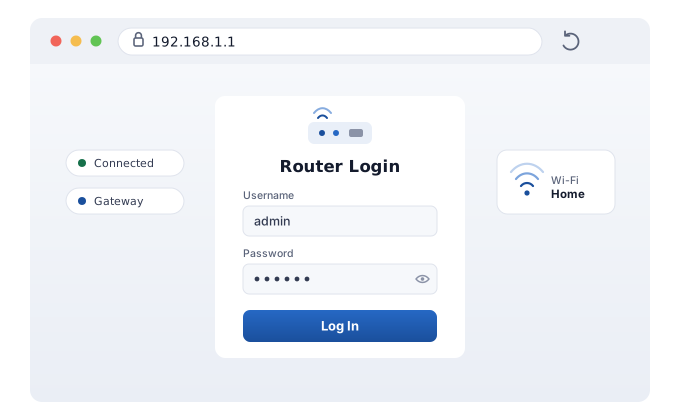
192.168.1.1 is a private IPv4 address that most home routers use as their default gateway. When you type it into a browser on any device connected to your network, you reach the router's built-in administration panel, which is the control room for your entire home network. From there you can change your Wi-Fi password, see which devices are connected, set up parental controls, configure port forwarding, and install firmware updates.
The address is part of the 192.168.0.0/16 private range defined in RFC 1918 and is completely invisible on the public internet. It only works inside your local network. That is why millions of homes worldwide can all have a device at 192.168.1.1 simultaneously without any conflict.
How to Find Your Router's Actual IP Address
Not every router uses 192.168.1.1 as its default. If the page does not load, you probably just need the right address for your specific router. On Windows, press Win + R, type cmd, press Enter, and run ipconfig. Look for the line that says Default Gateway under your active network adapter. That address is exactly what to type in your browser. On macOS or Linux, open a terminal and run ip route show default instead.
How to Log In to 192.168.1.1
The process takes about two minutes on any device. The only firm requirement is that you must be connected to the router's network first, either through Wi-Fi or a physical Ethernet cable. Logging in over mobile data or a neighbour's Wi-Fi will not work because 192.168.1.1 is a local-only address that does not exist on the wider internet.
-
1
Connect to your home network
Connect your device via Wi-Fi or Ethernet cable. You must be on the same network as the router.
-
2
Open http://192.168.1.1 in a browser
Type
http://192.168.1.1with the http:// prefix explicitly. Without it, browsers search instead of navigate. -
3
Enter your router credentials
Try admin/admin (Asus, Linksys, D-Link) or admin/password (Netgear). The label on the bottom of your router shows the current defaults.
-
4
Change passwords on first login
Set a strong admin password and a new Wi-Fi password. The default credentials are publicly documented and unsafe to keep.
Logging In from a Phone or Tablet
Connect to your home Wi-Fi first and confirm your phone is not using mobile data, then open any browser app and navigate to http://192.168.1.1. Most router admin interfaces are responsive enough to use on a phone screen. For more involved tasks like setting up port forwarding rules, a laptop is noticeably more comfortable, but for changing a Wi-Fi password or checking connected devices a phone works perfectly well.
Default Router Credentials by Brand
All brandsThe credentials below are the factory defaults shipped with each brand's home router line. Keep in mind that the same brand can use different defaults across different product generations, so the sticker on your specific unit always takes precedence over any list you find online. Use this table as a starting point when the label is unreadable or missing entirely.
| Brand | Category | Username | Password | |
|---|---|---|---|---|
Linksys Velop, EA and WRT series |
Consumer | admin |
admin |
Guide |
TP-Link Archer, Deco |
Consumer | admin |
admin |
Guide |
Netgear Nighthawk, Orbi, R-series |
Consumer | admin |
password |
Guide |
D-Link DIR and DSL series |
Consumer | admin |
blank or admin |
Guide |
Asus RT-AX, ZenWiFi |
Consumer | admin |
admin |
Guide |
Belkin N-series, older Wi-Fi routers |
Consumer | admin |
blank | Guide |
Cisco (home) Valet, older Linksys-era routers |
Consumer | admin |
admin |
Guide |
Arris Surfboard, TG-series |
ISP gateway | admin |
password |
Guide |
Huawei HG and B-series, LTE routers |
ISP gateway | admin |
admin |
Guide |
Zyxel VMG, NBG series |
ISP gateway | admin |
1234 |
Guide |
Technicolor TG-series gateways |
ISP gateway | admin |
admin |
|
Sagemcom F@st series gateways |
ISP gateway | admin |
admin |
Guide |
3Com OfficeConnect |
Business | admin |
admin |
|
Adtran NetVanta, Total Access |
Business | admin |
password |
|
Verizon FiOS G1100, G3100 |
ISP gateway | cusadmin |
highspeed |
Guide |
Tenda AC and N series |
Consumer | admin |
admin |
Guide |
MikroTik hAP, RouterBOARD |
Business | admin |
blank | |
Ubiquiti UniFi, EdgeRouter |
Business | ubnt |
ubnt |
Guide |
Buffalo AirStation |
Consumer | admin |
password |
Guide |
AVM Fritz!Box Fritz!Box 7590, 7530 |
Consumer | admin |
printed on device | Guide |
SonicWall TZ series |
Business | admin |
password |
|
Fortinet FortiGate |
Business | admin |
blank | |
Google Nest Nest WiFi, Google WiFi |
Mesh | App only, no web panel at 192.168.1.1 | Guide | |
Amazon Eero Eero 6, Eero Pro |
Mesh | App only, no web panel at 192.168.1.1 | ||
Troubleshooting When 192.168.1.1 Does Not Work
Connection errors when trying to reach 192.168.1.1 almost always have a simple explanation. Work through the steps below from top to bottom. The overwhelming majority of cases are fixed by steps one, two, or three.
-
1
Confirm you are connected to the right network
Your device must be on the same network as the router. Check that your Wi-Fi is connected to your home network and not a neighbour's hotspot or a corporate VPN that has its own routing. Plugging in an Ethernet cable is the fastest way to eliminate Wi-Fi as a variable.
-
2
Check your actual Default Gateway address
Your router may simply use a different default IP. On Windows run
ipconfigin Command Prompt. On macOS or Linux runip route show defaultin Terminal. Use the address shown next to Default Gateway rather than 192.168.1.1. -
3
Try an incognito window or clear the browser cache
A stale cached redirect is one of the most common causes of the login page failing to load. Open an incognito or private browsing window and navigate to http://192.168.1.1. If that works, clear your main browser's cache and cookies through the settings menu.
-
4
Disconnect any active VPN or proxy
VPN clients reroute your device's traffic through an external server, which makes local addresses like 192.168.1.1 unreachable. Disconnect the VPN completely, not just pause it, then try again. Some browser-level ad blockers and privacy extensions can cause the same problem in incognito mode.
-
5
Restart the router
Unplug the power cable from the router, wait a full 30 seconds, then plug it back in. Give it 90 seconds to fully boot before you try again. Over time routers can accumulate small memory issues that stop the web interface from responding even though internet access is still working fine.
-
6
Switch to a different browser or device
Some browsers block plain HTTP connections to local IP addresses under certain security settings. Try a different browser, or better yet connect a second device via Ethernet and test from there. If the login page loads on the second device, the issue is browser-specific on the first.
-
7
Factory reset the router as a last resort
If internet is working but the admin panel is completely inaccessible, a configuration error has likely locked you out. Find the small pinhole Reset button on the back or bottom of the router and press it with a straightened paperclip for 15 to 30 seconds until the indicator lights flash or cycle. The router will reboot with factory defaults. You will need to reconfigure your Wi-Fi name and password afterwards.
Router Security Tips After First Login
Most home routers leave the factory with identical login credentials that are freely available online. A neighbour, a visitor who connected to your Wi-Fi, or any device that joins your network can open a browser and reach your admin panel using those defaults unless you have changed them. The steps below take about ten minutes total and address the most common real-world security gaps.
- Change the admin password immediately
- Use WPA3 encryption on your Wi-Fi
- Set a strong unique Wi-Fi password
- Rename the network (SSID)
- Disable WPS on the router
- Turn off remote management
- Create a separate guest network
- Keep firmware updated
- Enable the built-in firewall
- Check connected devices regularly
Why Firmware Updates Actually Matter
Router firmware is software, and every piece of software has vulnerabilities. Manufacturers release patches on a rolling basis, some of which fix security flaws serious enough to give an attacker full access to your router without knowing any password. The process takes about three minutes inside your admin panel under a section typically called Administration or Advanced. If you see an Auto Update option, enable it. If not, checking manually every couple of months is a reasonable habit.
Guest Networks Are Worth Setting Up
A guest network creates a completely separate Wi-Fi segment that can reach the internet but cannot communicate with your main devices. Your phone, computer, and NAS drive stay isolated from anything connecting through the guest network. This is particularly useful for smart home devices like TVs, cameras, and thermostats, which often have weaker security than laptops and phones. Setting one up typically takes about three minutes inside the wireless settings section of your admin panel.
Typed It Wrong? You're in Good Company
A huge share of visits to this address start with a mistype, and the browser's response ranges from a search results page to a scary connection error. The classic culprit is the letter l standing in for the digit 1, they sit next to each other visually, and in many fonts they're near-identical. If any of these look like what you typed, the address you want is plain 192.168.1.1, all digits, no letters:
| What gets typed | What's wrong with it |
|---|---|
192.168.l.l / 192.168.l.1 / 192.168.1.l | Lowercase L instead of the digit 1 |
192.168.I.I | Capital i instead of 1 |
192.168.o.1 | Letter O instead of zero (that one belongs on 192.168.0.1) |
19216811 / 192168.1.1 / 1921681.1 | Dots missing or misplaced, every dot matters |
192.168.1.1.1 / 192.168.11 | Too many or too few groups, an IPv4 address has exactly four |
168.192.1.1 | First two groups swapped |
192,168,1,1 or 192 168 1 1 | Commas or spaces instead of dots |
www.192.168.1.1 or 192.168.1.1.com | It's an IP address, not a website, no www and no .com |
https://192.168.1.1 | Not wrong exactly, but most routers have no certificate, so use http:// if the secure version throws warnings |
Browsers make this worse in a sneaky way: type something that isn't quite an address and instead of an error you get a web search for it, which is quite possibly how you landed here. No harm done, the button below goes to the real thing.
Frequently Asked Questions
What exactly is 192.168.1.1 and what does it do?
Is 192.168.1.1 the default gateway for all routers?
ipconfig on Windows or ip route show default on Linux and Mac, then look for the Default Gateway entry. That address will always load the login page.Why does the 192.168.1.1 page refuse to load?
I forgot my admin password and the defaults do not work. What now?
Can I log into the admin panel from my phone?
Can someone access my router from outside my home?
Disclaimer
All information on this page is provided for educational and informational purposes only and is intended to help people access and configure their own networking equipment. Attempting to access a router or network device you do not own or do not have explicit written permission to administer may violate computer fraud laws in your jurisdiction.
Default credentials listed here are drawn from publicly available manufacturer documentation. We do not encourage unauthorised access to any device or network. Always verify technical details against your specific router model's official documentation or the label on the physical device.